
How to obtain a diving certificate
as a family
How to get started
When you want to get your diving certification, there are two world-leading certifications: PADI and SSI. The difference between them is minimal, the quality is high, and they are both equally widespread worldwide. No matter where you dive in the world, both standards are recognized, and training and safety are largely the same, so it doesn't matter whether you get your certification at a PADI center or an SSI center. We work with both leading SSI and PADI diving centers. Which certification you take depends on the destination you choose. If you have any questions about certification and standards, just ask us.

Taking the PADI/SSI Open Water course is a super exciting experience! You will explore the 70% of the Earth's surface that is covered by water—and there is so much to see and experience.
We recommend that you start by obtaining a PADI/SSI Open Water certificate. The whole family can do this together.
Once you have passed the diving course and become certified PADI/SSI Open Water divers, you can participate in diving trips and diving tours, as well as rent diving equipment for private use worldwide. You will be able to plan and dive with other divers, down to a depth of 18 meters.
All you need to do is:
Be at least 10 years old
Be in good health
Could tread water/float for 10 minutes.
Could swim 200 meters
step by step
Diving certificate
When obtaining your certification through PADI and SSI, the course consists of a theoretical part, which is e-learning, and a practical part, where you perform exercises in the water and gain experience that reinforces the theoretical foundation you have acquired through e-learning. We recommend that you complete the theory (e-learning) at home so that you don't have to spend time on it during your vacation.
-
The e-learning part takes place online and consists of text richly illustrated with images and fact boxes, along with videos to support the reading material.
After each section, there is a test so you can see if you have understood what you have read.
The e-learning part is super engaging and relevant, and it can be a really fun and educational way to hang out before you go diving together.
The entire e-learning section concludes with a test, where you must answer questions based on everything you have read.
PADI and SSI state that the e-learning portion takes 15-30 hours to complete.
In our experience, it takes around 15-20 hours for the youngest children to complete, so set aside a few afternoons for it and enjoy yourselves.
-
Typically takes 3-4 days and includes some sessions in calm water/pools and on land, where you practice various diving skills.
In addition, there are usually 4 dives in the sea over 2-3 days.
The practical part usually lasts 3-5 days, depending on the pace and weather.
Often, the final dives can be completed together with others who already have their certification. This gives the family the opportunity to dive together early in the certification process – even if not everyone is at the same level.
-
If you want to get your diving certificate while traveling, we recommend setting aside at least 7 days so that you have time for both the course and relaxation—as well as a little leeway for any delays.
If you are traveling to Bali, 10 days is a good minimum.
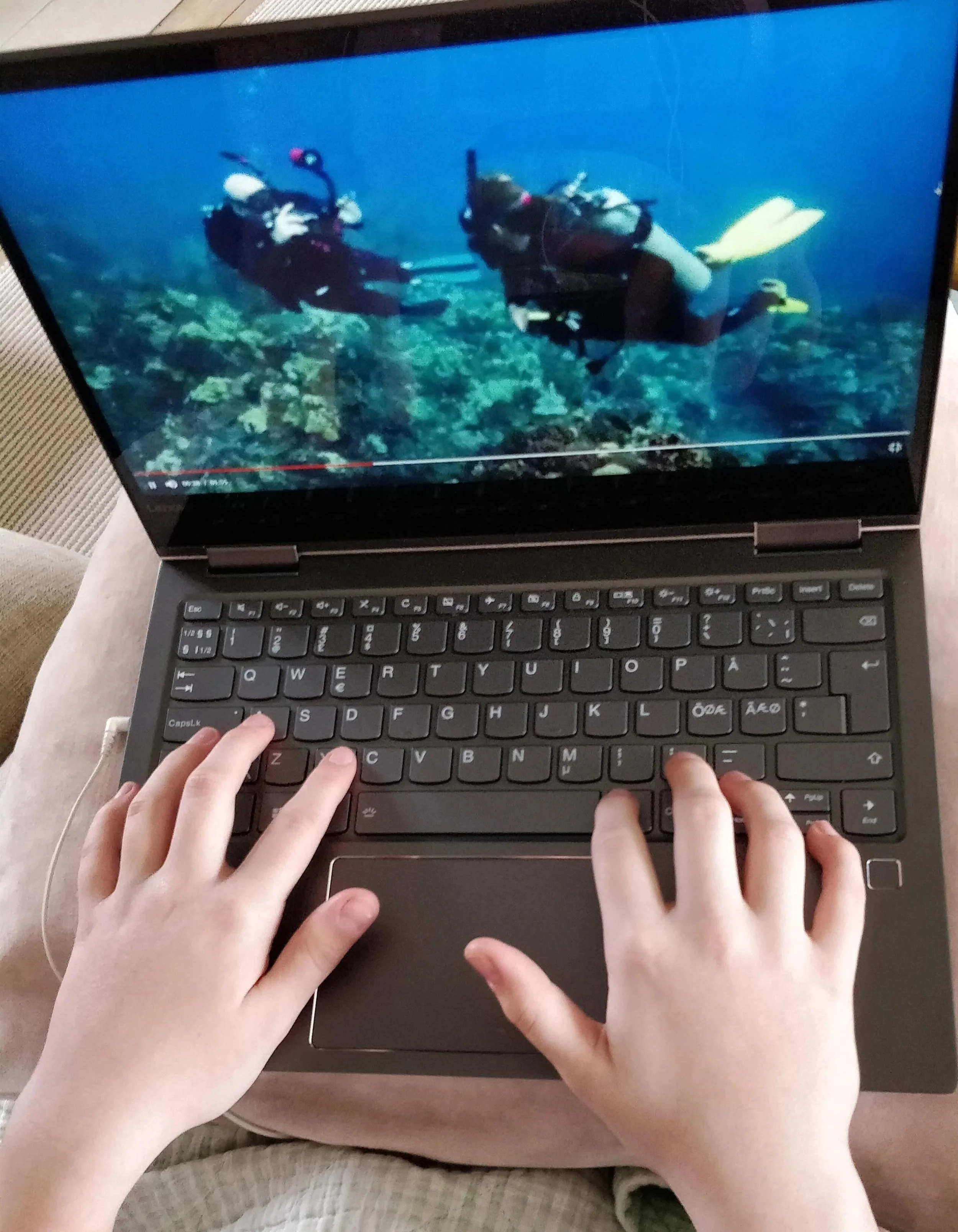
This is how our children started theirs
diving adventure
At home, our youngest daughter Lea took the e-learning part online when she was 10 years old. We recommend taking e-learning in English so that you learn diving terms and concepts in the language you will most often encounter when diving around the world.
Lea started out sitting with one of us parents and talking about individual words and what was explained, but gradually Lea became self-motivated and eager to move on without having to wait for us to have time to do it with her, so she did it herself, and then we took the tests together with her and her older siblings.
Having taken the online/e-learning part in English was a clear advantage when it came to the practical part, as it covered the specific English words used in diving.
When our three children, aged 18, 16, and 13 took their Advanced certificates in the summer of 2021, they had also completed e-learning from home before the practical part. They enjoyed meeting up every time there was a test (and set deadlines for when they had to be ready to take the test), and then comparing their answers and why they had answered that way—it was a bit of a competition!
For us, e-learning wasn't just preparation for diving, but a shared experience that brought joy, camaraderie, and lots of laughs along the way.